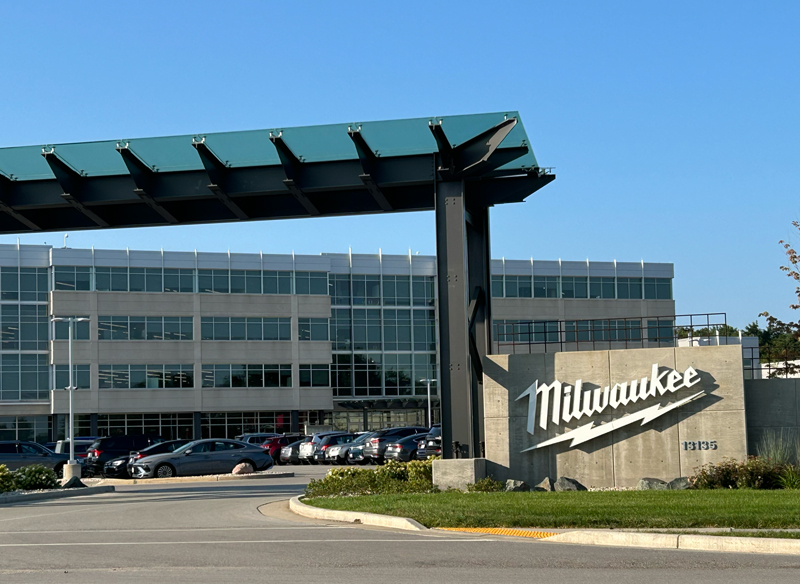
Cadillac and Chevy cars come from the same ownership group. So do Genesis and Hyundai, Porsche and Volkswagen, and also Milwaukee and Ryobi equipment and tools. You probably knew that already, but I’ve always found it interesting. And I was reminded of this OPE family connection when I read that financial statement from Milwaukee/Ryobi parent TTI Group that covered its business from the first half of 2026.
As I reported in August, TTI recently revised its reportable segment structure, replacing its former business segments of “Power Equipment” and “Floorcare and Cleaning” with “Professional” and “Consumer.” The Professional segment delivered sales of $5.9 billion in the first half of 2026, an increase of 9.7% in reported currency. The Consumer segment delivered sales of $2.4 billion in the first half of 2026, a decrease of 2.5%.
Steve Richmond, TTI Group CEO, said this change “better reflects how we run the business every single day. Professional is led by Milwaukee. Consumer is led by Ryobi. Together, these core brands now represent 93% of our sales. Both delivered exactly what we expect of them in the first half of 2026.”
The current story of Milwaukee Tool is about much more than just “sister of Ryobi.” I got an opportunity to sit down with two marketing leaders whose work includes outdoor power equipment. Christian Coulis, sr. VP of product marketing; and Tony Buxton, VP of product marketing gave me an hour of their time recently to discuss Milwaukee’s OPE business, its connection with Ryobi, its retail sales channel, and more.
Interview Highlights
“We’re able to use our group purchasing power to get to the front of the line and create powerful partnerships and priority within the supply chain network. That being said, we don’t reuse, we don’t share designs, parts or components. You break open the two different brands and they’re different products.”
“You’re not going to see a bunch of ride-on equipment from us anytime soon. Our focus will be supporting the systems that we have. And in growing those out.”
“We feel the biggest opportunity within the industry is still going after gas conversion.”
“It’s large right now. [Home Depot sales volume percentage] I don’t think we can disclose the exact amount, but it’s a large portion of the business right now.”
“It was a tough decision at the time for the organization, [removing Milwaukee Tool products from Amazon] but I think in hindsight, it’s been a very comfortable and good one.”
“Across all of our products, we’re averaging about 7 days turnaround time. [Milwaukee’s new equipment service plan] From the time it gets FedExed out to the time it gets back in the hands of the customer.”

Interview Transcript
In Power
I want to start with how outdoor power equipment fits in this world of power tools that are otherwise mostly made for construction trades?
Tony Buxton, VP of Product Marketing
We take more of a vertical focus. A lot of our users are using a pretty wide range of all the different categories and products within landscaping or tree care. Obviously, outdoor power equipment is the larger focus, but we see a lot of usage of some of our other solutions that may have been designed more on the construction side that have some sort of correlation with the outdoor space, whether it’s maintenance in the shop, or if users are taking on any incremental hardscaping or irrigation tasks. Our focus is more on the user vertical and understanding their needs, offering a wide range of solutions versus the category focus.
Christian Coulis, Sr. VP of Product Marketing
Our whole business is structured around supporting these user trades, the user verticals. And the history, we are a 100-plus year-old brand, and we started was the MEP world: mechanical, electrical, and plumbing.
Over the past decade or so, that’s expanded to a handful of other trades. That means there’s a robust product and commercial execution strategy to support it. So, to Tony’s point, landscape maintenance and tree care are both part of what we consider our core verticals. We put a focus on, not just on product solutions, but how we go to market and support the service, the selling, the dealer footprint, the distribution footprint of it.

Tony Buxton
If you take a look at when we got into outdoor power equipment versus now, it’s evolved quite a bit. We introduced our first solutions back in 2017, started working on them in 2015. A lot of the focus then were the core trades. We were not focused on landscaping or tree care, but a lot of users across our core trades were looking to get more out of their system investment into M18 [batteries]. And there were a lot of either primary or supplemental tasks where outdoor power equipment had a fit within our core trades.
If you look at plumbers or electricians, after doing rough in, they can do a lot to clean up using a battery powered blower a lot faster than using a push broom. With it being battery powered, you can use it indoors. If you look at power utility, a lot of usage of outdoor power equipment as core tasks. They’re cutting utility poles with chainsaws. They do a lot of line clearance or right-of-way clearance with pole saws, hedge trimmers, brush cutters, things of that nature. A lot of our historical core trades are looking to get more out of the M18 system and are demanding outdoor power equipment products on the M18 battery platform.
About a decade ago, there were not a ton of high-end battery-powered solutions. But we put our best foot forward to deliver best-in-class products. Some may have been designed toward a different use case, but we saw landscapers and arborists starting to pick up our solutions as more of a supplement at the time, or maybe for early morning starts, where noise levels were critical, or if there were any property-specific requirements on emissions generated on the property. These users were picking up our products as a supplement to gas. And they recognized, ‘Hey, Milwaukee Tool has something here. These are very compelling products.’
That user base started asking for more from us, which is how we’ve bolted on a lot of new core trades over time. Like Christian said, it started with mechanical, electrical and plumbing. As we’ve gotten into more of these focus areas, adjacent user groups started picking up those products.
In Power
So is OPE a growing category? Do you a specific growth goal for outdoor power equipment?
Christian Coulis
It is growing category force and has been over the last 5, 6, 7 years; it’s really become a primary focus. Our company’s healthy; I’m sure you’ve looked at the financial reports. Our expectation is that this category will be accretive to the growth of the organization.

So we see nothing but opportunity, both in terms of conversion from gas into electric for the professional landscapers and arborists using this product. But also as our systems get much larger and more trades that maybe aren’t professional landscapers in the system and will have to use the product. So it’s kind of both, right? Our charter, our goal with this category is to create the best product that we can for professional landscapers and convert the gas industry.
We’re seeing big growth there, growth over everyone else.
Tony Buxton
Looking at the pro landscape maintenance and tree care market, We look at it as nothing but upside. We’re in a different position than some of the legacy brands within the space that are protecting a gas business. All of them have stepped into battery and are looking to transition that customer base in. But for us, we don’t have that legacy business within the pro landscaping or tree care space. So for us, it’s all upside, incremental opportunity, because that market is still very heavily dominated by gas, which we fully acknowledge and understand.

Christian Coulis
We have the benefit of being pretty diverse from a product solution standpoint. It’s not just landscaping equipment. A lot of other types of handheld or small equipment that require significant battery capacity and charge rate and duty cycle as well. We’re able to leverage the learning, leverage the history, leverage the investments that we have as a company, to be able to make a really good impact for this user group. At our Pipeline event a couple weeks ago, we announced the best battery that we’ll have. It goes up in capacity, goes up in charge rate, goes up in capability in significant ways.
We have new charging solutions as well that will really help support the people looking for better alternative than the product they’re using today.
In Power
How do you track or know pro versus residential? How does TTI know with Milwaukee and Ryobi? You make assumptions, right, about a Ryobi buyer versus a Milwaukee buyer? But how do you gather that data and trust that it’s this buyer, that buyer?

Christian Coulis
There are a couple of different ways. But, number one, we don’t sell anything directly. We only go through channels of distribution. So we don’t have the register information. It’s not our data; we don’t have it. Customers don’t share it with us.
We have a lot of in-field resources focused on landscaping and we have a lot of partnerships and connections with professional landscapers and arborists within the key markets that we’ve grown into. So we’ve got feet on the street.
We have a connection with these companies. We understand what they’re using, we understand the adoption rate, the conversion rate, and what types of areas we’re seeing a faster transition versus others. And that’s both by market and region depending on the type of work being done.
But it could also be separated by type of property they’re serving. People cutting and maintaining the side of the road, like down the highway, much different than a university system or a golf course. So pros come in a lot of different definitions as well.
It’s something that we try to get as much information as we can. It’s not exact, but it’s directional, and we can understand what we believe the adoption rate is, and at least within some of the customers that we’ve got good relationships with, we have more of a peek behind the curtain, so to speak.
TTI and Ownership
In Power
Other than corporate ownership, is there any connection to Ryobi? Do you collaborate, or do you share anything?
Tony Buxton
There are certain aspects that we intentionally keep separate; the customer base that Ryobi’s targeting is different than ours. So it gives us the opportunity to capitalize on different areas. There are certainly shared learnings when it comes to any regulatory testing that may be coming through, the requirements that a consumer product or a professional product need to pass. They are the same.
So there are a lot of synergies, especially considering Ryobi on the outdoor side. They have a bit more history and time within that product category. So there are certain insights that are shared. But from a design perspective, we are not sharing components in designs and trying to just lick and stick different things. We have dedicated design teams for both the Ryobi and Milwaukee side of things.

Christian Coulis
On top of that, it’s a supply chain. We use many different designs, different components and parts. But in some cases, it’s the same supplier, whether it’s a raw component or electronics supplier.
We love analogies. It’s a lot like the automotive industry. There are different tiers, different brands. The vehicles are different. The parts are different, but they can control the supply chain a little bit more. And we have the benefit of TTI’s collective volume as an organization, especially with all the challenges that have happened in the last 5 or 6 years between tariffs and chip shortages and lithium shortages. Everything you’re reading about in the news affects this industry directly.
And we’re able to use our group purchasing power to get to the front of the line and create powerful partnerships and priority within the supply chain network. That being said, we don’t reuse, we don’t share designs, parts or components. You break open the two different brands and they’re different products.
In Power
I visited a Hart Tools event a couple years ago in South Carolina; they seemed to be pretty aggressive with marketing and products in Walmart. I was kind of surprised when they discontinued the brand.
Christian Coulis
As a company, we are very focused on what we described earlier as our targeted user verticals, targeted partners and channels that we want to serve long term. I think that was, more than anything, the ability for us to reshuffle and prioritize on our top initiatives and the top corporate priorities.

Equipment Line Expansion?
In Power
Back to product for a bit before we get into retail. I’m fascinated by batteries. The way you and Ryobi, in particular, have grown product lines to maximize the capabilities for a user to not have to own a million batteries. So, more expansion of Milwaukee products, and specifically, will there be more wheeled equipment?
Christian Coulis
Earlier this month we showed a little bit of that. The M18 walk-behind spreader. Yes, there will be some of that. As our battery capability and capacity go up, you’ll see future generations of things on wheels, things on backpack straps. I would say for the near term, you’ll see us take that technology and do the absolute best we can within the market and the industry on the handheld equipment too.

So it’s going to be a little bit of a spread. I think the balance will be appropriate. You’re not going to see a bunch of ride-on equipment from us anytime soon. Our focus will be supporting the systems that we have. And in growing those out.
Tony Buxton
There’s an element of understanding where we are from a technical readiness perspective and how well that matches up to the user need. But also factoring in the cost and return on investment tied to that as well. I think over time, even in other areas, we’re never going to say “No” forever, but we’ll do it when it’s right to do it.
Who is Your Competition?
In Power
Who is your main competitor? Who do you guys think of often when you have meetings and talk about products? We need to go after (fill in the blank).
Tony Buxton
There are a number of different buckets in terms of who we consider competitors. And I think looking at the outdoor power equipment space, there’s been a ground swell of existing brands going after battery, as well as new emerging brands coming into the space. We look at it in three different buckets.
1. We have the legacy power tool manufacturers that have gotten into OPE with Makita, DeWalt.
2. You have your legacy gas brands that are getting into battery OPE including Stihl, Echo, Husqvarna.
3. And then we have new emerging brands that are focused on OPE, but newer to the space, when you look at Greenworks, Ego, Kress. There are probably a lot of competitors that are secondary to that, but everybody comes with a different approach, different value proposition. It depends on which angle you’re coming from, of who we would consider the top threat to either just the Milwaukee OPE business or the broader Milwaukee tool business.

Christian Coulis
We are a professional brand, though. We do everything we can to drive innovation around productivity and safety on sites and on properties. So that is where we’re going to stay focused on that end of the market and not the low-end commoditized end of the market. And that narrows down the focus of competitors, a lot. We feel the biggest opportunity within the industry is still going after gas conversion. So we look at that as something that we need to combat from a product delivery and ROI standpoint.
In Power
I went to a Greenworks event when they launched their Walmart relationship a couple months ago. Your name came up as much as their name came out. Whether people acknowledge it or not, when I’m doing meetings like this, some names come up more than others.
Christian Coulis
We are wired to deliver the best we can do in this industry. And that will immediately, in our mind, put us ahead of any competitors. So we’re hyper aware. We test and we get our hands on as much stuff as we can and learn where we can. But we are, I would say, more focused on delivering the best thing for our customer base than trying to deliver 5 or 10% better than a product that has a different color. That’s our focus and that’s what our team spends time on out of this office, out the in the field. Trying to learn the biggest pain points and biggest frustrations that people have.
The Sales Channel
In Power
I want to talk about retail for a minute. What does retail look like for you over the next few years? Will you continue to focus on Home Depot? How about smaller regional outlets like Acme Tools? And independent power equipment dealers?

Christian Coulis
We are fairly diverse from a distribution footprint, whether you want to define it as retail or other, I’ll explain that in a second. I would say our focus around the core verticals that we talked about earlier are taking us into areas where our brand traditionally hasn’t been.
We don’t sell through all retail channels. You’re not going to find us in Costco or Menards or Lowe’s. We don’t sell through Amazon. From a national retail footprint.
Home Depot is our largest partner, for sure. They’ve been a partner for a long time, and we continue to grow together with them. That will continue from landscaping and outdoor power standpoints as well. And we have a lot of plans in the future to continue to build out the line and have good solutions for that setting.
Within our business, we’re structured in a few different channels of distribution. We have retail, which is predominantly Home Depot, and we have some other more traditional hardware and farm channels. You’re familiar with Rural King, Ace Hardware, and those are traditionally powerful channels within this targeted market. And because of our historic focus, we have this industrial and what we consider national account footprint, like Grainger’s. The industrial is more customers like Acme Tools that have outside sales forces.
They’re going to their markets and engaging with the professional contractors, whether it’s a traditional construction contractor, or one focused on landscaping. And we’ve started to build out our landscaping dealer network as well, and we continue to put more focus on it.
I would say the biggest opportunity we have right now within retail is supporting and driving awareness and education around the breadth of line that we offer. It’s not just a string trimmer and a leaf blower. We have dozens of products designed, developed and built for the professional landscaper or arborist. And in a retail footprint, it’s hard to get all of that on a shelf so everyone can see it and understand it all the time. Outside of that, all the adjacent products, ratchets, high torques, grease guns, compressors, PPE, storage, hand tools, the outdoor accessories that we now offer. The basket of goods is big.
In a retail setting, it’s limited. It’s difficult to show everything and make sure that everything that we would want to support that customer is in front of them, and it’s very clear what the advantage is all times.
I don’t know if this is answering your question, but within our strategy for retail, we’re looking at not just mix, breadth of product, where it is, what’s next to it, the signage, the messaging, that is not only in store, but then what we have online with these partners of ours to be able to capture that customer as well.
In Power
How much percentage wise is Home Depot for your sales? 75%?
Christian Coulis
It’s large right now. I don’t think we can disclose the exact amount, but it’s a large portion of the business right now. We’re seeing it grow and we’re seeing the other channels that are less traditional retail grow as well, so we’re seeing opportunity in both places. And it’s a little bit different from a timing and seasonality standpoint where the timing of the shipments, the timing of the big promotions, and the load-ins are staggered depending on the scale that we’re talking about.
Tony Buxton
The products we sell at Home Depot are the same products we sell through more of the pro dealer network as well. You’ll see a lot of our competitors offer different products with different specs and price points to be able to go after a certain customer base. But what we’re selling through retail, Home Depot, is the same product we’re selling elsewhere. We’re not looking to chase those low-price points just to drive sales, leverage our brand equity against that. We want to make sure we have that pro focus across the board. And there are a lot of different types of pros that we’re ultimately trying to support.
I think another big aspect of our positioning and messaging, within every environment that we sell in, is driving credible education around how to think about battery power, especially for that user converting from gas to battery. They don’t really know what to expect. How does the product compare? What can I expect in terms of the performance and productivity versus the gas solution I’m used to?
One of the biggest unknowns is how much runtime or work they can do on a single charge to really understand how many batteries they need to invest in to complete a full day of work. What are the different options when it comes to charging, whether you’re trying to do everything overnight in a shop or leverage access to power at one of the properties versus charging mobile out of a trailer?
We try to drive credible education. When it comes to marketing, there are a lot of examples where some brands will try to cherry pick the box clean that they put to market how much work you can get done, a lot of examples of brands saying, hey, you’ll get an hour and a half of runtime on this blower, but it’s actually being run in the lowest blowing force setting, that can’t actually get anything done.
So when you take a look at the messaging that we’re either putting out in stores or online, we will show, against various applications, the exact amount of work that a user can expect to get done. But the focus is in-application, under a load, full throttle. In a lot of instances, our competitors are doing no-load claims. It is great that you can get an hour and a half work done if you’re just running a string trimmer in the air, not doing any work, but it doesn’t translate to the application, and it can be misleading. We try to put as much credible information out as possible to make sure the customer understands what they’re going to get and how to think about right sizing their overall investment in the battery powered.
Christian Coulis
That’s where a lot of burden comes back to the place that sold the equipment. If the box claims don’t match up with what the person’s actually experiencing, they’re going to come back to the store and try to work through it with them. And that’s where it becomes a burden and a drag on everybody, including a customer, which is the worst part.
Ecommerce trends?
In Power
You said you’re not on Amazon. Why not?
Christian Coulis
We feel like we can leverage the partners in the distribution channels that we have today to get in front of the right people. with our brand and our product, and it gives us ultimate control. We used to be [on Amazon]. And the ability for third party sellers to come into Amazon and, not just undercut the partners that we have, but also lose track of … Like there were some issues there where it looked like it was a Milwaukee tool, and it looked like it was coming from our brand, but it wasn’t. That became a little bit tough to police.
We decided strategically to narrow it down and partner with the companies that we feel like we have a deeper and longer relationship and opportunity with. It was a tough decision at the time for the organization, but I think in hindsight, it’s been a very comfortable and good one.
In Power
But people can buy from Home Depot online, and pick up in store, or ship to home, right?
Christian Coulis
Absolutely. And we’re seeing that area of the business, not just Home Depot, but you mentioned Acme Tool, AcmeTool.com. We’ve seen the online portion of the business grow significantly as a percentage of sales, not just within landscaping, but all categories. Think about how you shop. The surprising thing is with some of these larger items. People don’t have a hesitation with getting those things delivered.
Tony Buxton
We want to make sure we have all the options, and if you look at a lot of our distribution partners, their e-commerce sites have come a very long way.
And it’s a different dynamic on the outdoor side of things. Early on when e-commerce was being built up, with a lot of the outdoor space being gas at the time, a lot of brands weren’t willing to ship their products. They want you to go into a dealer, have that dealer fill it with gas and oil, make sure it’s running right, start it up. The shift to battery has changed some of those buying behaviors. But not everybody wants to shop online. We see it as a good resource to learn and drive education, even if you’re not making that purchase online, because the level of detail and perspective that we can provide online looks a lot different than what you can accomplish in store with pretty minimal footprint to drive education and messaging.
Service Evolution
In Power
How are you talking about service? I think I saw on your website, a service helper, that owners can ship product for service. How is service going?

Christian Coulis
This is actually a cool topic. Taking care of the customers is primary objective number one. And if someone is invested in a Milwaukee product and has an issue with it, we want to bend over backwards to make sure they have a positive experience. We’d be fooling ourselves if we said there would never be any issue with anything. We put a lot of work into making sure we have the best product we can, a really good warranty, and hopefully there’s never an issue. But the environment that these things get used in, something will happen eventually.
We’re evolving this over the years. So where we are right now is we have a robust set of options.
Number one, what you just hit on is e-service. This is probably the fastest growing and most used version of service for us right now. You go online, you type in the serial number or model number, the product and you can print off a FedEx label. You ship the product to one of our repair hubs that we have throughout the country. And that’s prepaid by us. It’s shipped in on our dime. If it’s under warranty, it gets fixed, shipped back with no charge to the user.
If it’s not under warranty, that user will get an email or a call that explains what’s wrong and what the price will be, and when they’ll get it back. It’s their choice to fix it or not, and if they don’t want to get it fixed, we’ll send it back to them. They can pursue another option. That’s the most controllable for turn-around time. It’s coming to our facility. And we have a process that’s very well run. It’s still improving as well. to get that thing turned around.
Across all of our products, we’re averaging about 7 days turnaround time. From the time it gets FedExed out to the time it gets back in the hands of the customer. For outdoor power product, that’s a pretty low turnaround time considering you’re not waiting on parts. You’re not waiting on delivery. It’s something that’s controllable by the manufacturer.
A couple of other options, we do have a limited number of factory-owned service centers. These are brick and mortar Milwaukee branches around the country. If people are close to that area, it’ll actually be repaired on site unless that turnaround time’s going to be a little bit too long. It’ll be sent back and forth to that repair hub, like I just mentioned, to speed up the process. For larger items, blowers, snowblowers, push behind mowers, we have what’s called special products services. This is a newer solution for us. We’ll coordinate LTL pick up, and we’ll actually pick up the product. It’ll be sent to the closest factory service center and then redeliver it. It’s actually a little bit quicker than that 5-to-7-day turnaround time, because we put it front a line as soon as it gets to the facility.
And then we have a network of authorized service centers throughout the country too. So if someone’s in a market, they are used to dealing with a repair center that’s authorized by us. They can continue doing that as well. That’s not a brick and mortar, Milwaukee-owned store. It’s usually a dealer or a distributor of ours of some sort.
And then lastly, you can order the parts. If it’s something easy, if it’s a broken wheel or something like that, you want to get replaced. You don’t need to ship around the country. We have our service parts available. If it’s under warranty, it’s free. If it’s not under warranty, it’s a cost set that will be incurred.
But the in-field serviceability of products is a focus that we’re evolving to support and allow more easy replacement for repair of parts or components on a product in the field by the user. And some of those come with instructions and directions online that they can find as well.
The cool thing about this trend is we don’t make any gas equipment. It’s all battery. And the preventative maintenance aspect of it is huge as well, especially, I mentioned the supply chain in some of the issues that have happened in the market in the last couple years. Like we’ve heard stories of some of the equipment of significant backlogs and delays with parts. We have not had that. I’m talking about parts from gas engines, carburetors, things like that. The requirement on these regular maintained components is just not there with the electrification of the equipment.
Battery Design
In Power
Where do you assemble battery packs? Here, or do you get them from China?
Tony Buxton
We have a number of different facilities. A lot of it is happening in Asia currently. But we have a number of different facilities from both the procurement to the assembly and manufacturing process.
Christian Coulis
And in some cases, we’ve partnered with certain suppliers and companies that make the cell to make sure that we’re doing the absolute best thing we can within the products that we’re serving. It’s a little bit of a unique exposure at times. Think of the extreme heat, the extreme cold, the vibration, the dust, the metal ingress, the wood. The way they’re stored, how they’re charged. They’re handled. The variables are different than a car. Every time the industry advances, there are ripple effects to that.
We have a different and unique approach to that. We actually partner directly and bring the companies here. They go through a day in the life. We take them to the field. We take them to different sites, we put the product in their hands, and in their engineering team’s hands, and work with them on proprietary executions.
One of the biggest things outside of that is the construction of the pack around that cell. That’s something we’ve put more development in R&D and have more generations than anyone else in the industry. The new battery that we just announced a couple weeks ago is a testament to that. The development, and the investment that we continue to push behind it is significant.
Customer Connections
In Power
Let me ask about listening to customers. How do you connect with your customers? Are your customers getting what they need? Is Home Depot or Acme Tools a good solution for them to find what they need? Or listening on the service side, is this new service plan working, is a week turnaround okay?
Tony Buxton
It comes in a lot of different forms, depending on which topic you’re referring to. We have the benefit of really being connected to all elements of that. Our biggest focus within our team is the design and development of new products, and it all starts with the user. Regardless of which department you’re talking to here at Milwaukee Tool, it is all user centric, focused on whoever in the best experience possible for the users.
Looking at our team on the product management side of things, we spend an incredible amount of time in the field working directly with users. We have a growing team where we have a lot more specialization within certain categories or user groups, to really build that subject matter expertise. But the understanding of user needs comes in a lot of different forms. When we’re out in the field doing research, it could be observational research, where we are watching users complete their tasks, moving property to property to generate insights from that perspective.
There’s a level of anecdotal feedback, getting that voice of the user, understanding why they’re doing certain things, what tasks they’re taking on, what works well, what doesn’t, how can we learn from the products that they’re using today?
But then there’s also quantifiable research, where we do a lot of testing and data logging within the field. While that anecdotal feedback is great, especially when it comes to the touch and feel and the ergonomics of a product, sometimes the anecdotal feedback could be off when it comes to how long are you using a specific product on a property. How does that expand out to a full day, a full week, a full year, the life of a product? So, we do a lot of data collection to really understand exactly how products are used and pair that up with the observational and anecdotal feedback.
In Power
Do you have people in the field, people all over the country? In sales or marketing or tech training?
Christian Coulis
Yes, we do. Tony and my team are those people. It’s a product management team. I would say they spend somewhere close to half the time around the country. In the field, side by side, with the operators of the tool, with decision makers of the company, and they’ll certainly partner with their distribution partners as well.
I just got back last night, Sunday to Thursday, I was in the east side of the country, going to a bunch of different cities and talking with a whole bunch of different companies and users about product. What do you like? What don’t you like? What are the trends? Where are your biggest pain points? The frustrations?
And then to Tony’s point, what we have to capture and collect, actual data, through data logging is progressing now as well. And then the other part of the time, that team comes back here, works in conference rooms like this with the engineering teams, whether it’s mechanical, the industrial design, the electrical engineer, quality engineers. So a whole group of different skill sets and functions that start to work through the product ideas and actual projects, of things that we’re working on in the future.
Something similar happens with existing product, too. We want to stay very close to what’s happening in the field with our existing product. Is it performing like we intended it to? Do things need to be changed or adjusted or improved? On top of that, we have more commercially focused teams in the field for customer support and adoption, they do trials, they do demonstrations. If someone hasn’t used their product yet, is interested in it, or they’re using a different brand, we have the ability to go and partner with them and say, ‘Here’s how ours compares. Let me tell you about it but use it for a few days and we’ll follow up with you.’
Tony Buxton
And our sales team, we really have two different arms of it. We have a sales team focused on our distribution partners and the account side of things, making sure they have what they need to drive success. We also have an arm of our sales team that is completely user focused.
They are distributor agnostic. They’re not trying to drive someone towards one distributor or another. They are there as an extension of an end user’s business, helping them understand new products that are coming out.
This is a really critical area within landscaping tree care. How do I think about charging? How many chargers can I put on a circuit? How many circuits do I need to make this a reality? Especially if you have a lot of crews coming back to a single location at the end of the day, trying to support all of their battery-charging needs. That’s really helping get them set up, but then also, that’s post-purchase support across the life of the product.
Christian Coulis
This is really important to our company. The best product is not going to be made sitting in a conference room, looking at Excel spreadsheets. Get out and understand the customer, understand their application. And where are their pain points, where are their opportunities? Where are the pain points driven by product versus a workflow that doesn’t make sense?
Tony Buxton
Our design and development process is very thorough. We go through an incredible number of iterations of prototypes before we say, ‘This design is ready to go.’ We don’t just build a prototype and say, ‘it’s close enough. Let’s go.’
We have made massive investments a rapid prototype facility attached this building. We have a couple of others in the area where, if we get feedback on an early prototype of ‘Hey, I don’t like the grip of this, or the location of this feature,’ our product managers can bring that feedback to the office to our engineering team, and they have the ability to leverage our rapid prototype facilities to submit a CAD file and get 24-hour turnaround on 3D printed parts.
We also have the ability to do reductive processes where we take a chunk of steel and do different milling and other processes to build prototypes quickly.
That speed allows us to get feedback, make design iterations, and then immediately get back into the field with an updated prototype to ensure we address the feedback that we receive. We will go through a number of what we call rapid prototypes, where we’re making large scale changes to the product design. Then on the back end of a project, they’re no longer considered rapid prototypes. It’s actually building prototypes off the manufacturing equipment that we invest in.
But we do that rapid prototyping iteration process over and over again until we get it right. Then we make that capital investment in the manufacturing equipment. Beyond that, in the prototyping process, we’re not making large scale changes, but are trying to make sure, is it meeting the performance need? Are we getting the reliability, the durability that we expect, and our product managers are getting samples out in the field for months.
We also do a lot of laboratory testing or manual life testing, because most of our outdoor products have a three-year warranty. Our speed to market doesn’t allow us to test in the field for a full three-year period before we say, ‘hey, we’re ready to go.’ So we do a lot of expedited testing. It will be manual operators running the testing, but we can take three to five years’ worth of usage and get that down to about a six- to eight-week long test period where it’s multiple shifts, nonstop, running these tools to identify the failure point.
What’s next?
In Power will connect with Milwaukee Tool again at Equip Expo and look for:
- What are landscape pros saying about the company?
- How are the new batteries and charging products being received? Is “gas replacement” really possible?
- Does Milwaukee make enough variety of products to compete with a more OPE-centered manufacturer like Stihl or Husqvarna?
And what do you want to know about Milwaukee?

Leave a Reply