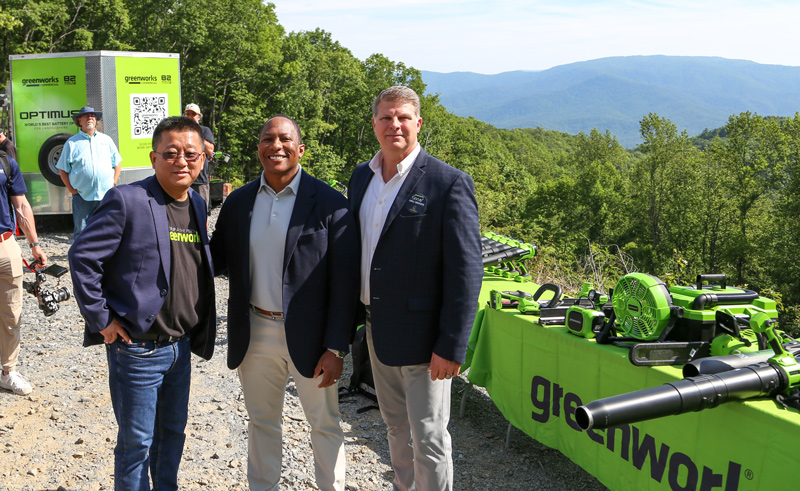
Greenworks continues its growth trajectory, announcing an expansion of its relationship with Walmart along with new tools in its new Greenworks 24V and 24V Pro Powerall lines. The product intro includes power tools and outdoor equipment aimed mainly at DIY homeowners. Greenworks claims it now has the largest assortment of 24V tools in the industry. To introduce this lineup, Greenworks and Walmart invited me and select media to an event north of Atlanta. We looked at and sampled new tools and equipment and spoke with executives of both Greenworks and Walmart.

“We’re really excited to kind of turn a chapter in our outdoor power and our power tool program at Walmart,” said Corey Bender, SVP, Lifestyles Merchandising for Walmart. “We know the customers are continuing to do DIY projects, they’re building out their backyard spaces themselves. And we really pride ourselves on providing customers with innovation, quality, and most of all value.”
Walmart is working to compete with Lowe’s and Home Depot in the retail battle for tool and equipment shoppers. While the two mass market DIY stores have increased their attention on pro users over the last few years, Walmart will most likely focus on price-conscious DIY homeowners to whom “pro” marketed tools are appealing. And the Greenworks expansion helps fill store shelf space left open when Walmart-exclusive Hart Tools ceased production.
Can Greenworks compete with Milwaukee Tools?
At the Greenworks event, the manufacturer provided opportunities to try its new 24V drills, drivers, grinders and saws. In these demonstration areas, it also provided competitive tools from Ryobi and Milwaukee. I was not there to compare the performance of Greenworks tools under limited time and space constraints. Greenworks was, however, working to show how its new tools compare in price with cost-conscious Ryobi and pro-level Milwaukee. I will come back to that.

First, I wanted to hear from Greenworks executives about the reasons for this brand expansion and the manufacturing capacity to deliver tool quantities that can satisfy a retail giant such as Walmart.

Kicking off the event, Greenworks CEO Yin Chen talked about his company’s development of battery-powered equipment for landscape contractors. “We have the battery technology to power their trailer,” he said, “and this is the first time in the industry when you have one brand able to take a zero turn, a walk behind, and also handheld and the recharging solution to be all packed in one trailer.”
Chen said Greenworks used that experience “to build tools for the trade person today.” Launching this new line of power tools, he talked about the shared platform that is essential for success in battery-powered equipment sales today. “The same 24-volt batteries that power your drill or driver can also power your trimmer and blower and mower.”
All manufacturers of battery-powered tools and equipment boast about the breadth of their tool platform. Ryobi says that more than 300 pieces of equipment are compatible with its 18V batteries. Dewalt claims 250 or more. And the expanding line of Greenworks 24V “PowerAll”-compatible tools includes more than 200 pieces of equipment. At the same time, Chen said, “Power is more than a collection of tools. It is one connected battery ecosystem designed around the way people actually live and work.”
Outdoor power equipment seems to be the growth area for manufacturers expanding their battery platforms. Dewalt talked about its growing OPE lineup at the Equip Expo trade show last fall. Milwaukee Tools continues to grow its line beyond construction contractors and into the OPE arena. And Home Depot-exclusive Ryobi still leads the OPE market share in the residential category. Seems natural for Greenworks to work the other way, expanding from its recent focus on pro landscape contractors and into construction and DIY power tools.
The company has actually manufactured battery-powered DIY tools for years (I tested Greenworks drills and circular saws several years ago while writing for Family Handyman magazine). But it is making a more concentrated marketing effort with this growing Walmart relationship.
Why is Greenworks expanding with Walmart?
As part of its Amazonification, Walmart is focusing on selling a little of everything everywhere, and that includes tools and equipment. And following the recent demise of Walmart-exclusive Hart Tools (in a “Business Update” dated Dec. 11, 2025, TTI announced the discontinuation of Hart Tools), the retailer needed to fill shelf space with affordable battery-powered tools, ideally tools with a stronger brand reputation than Hart. To be fair, Hart Tools, manufactured by TTI (parent company of Ryobi, Milwaukee and others), were never meant to be pro-grade items. They were designed and built to be – similar to Home Depot’s Ryobi offerings – affordable power tools for homeowners who use them sparingly.

Many of the new Greenworks power tools are priced to be Walmart friendly, even with Greenworks stamping some of its new 24V tools with the “Greenworks Pro” label. At the launch event in Georgia, the manufacturer boasted about its relatively low prices, while literally comparing many of its tools to the pro-focused Milwaukee products. Again, a full comparison of a new Greenworks circular saw to a similar Milwaukee product was not possible at this one-day event, though the circular saw in particular did perform well in a demo, even at about half of the retail price of the red branded tool (Greenworks at $119, compared to Milwaukee at $229).
Over the last few years, Home Depot and Lowe’s have battled to increase sales to pros and contractors, using increased pro-level tool and equipment inventories (Milwaukee or Bosch power tools, or a Husqvarna chain saw, for example) loyalty programs and other perks. It’s unlikely that pro contractors currently buying from these two big-box stores will switch their business buying to Walmart. But with 5,000-some locations, the Bentonville behemoth has geographical advantages that add convenience for contractors. And the Business.Walmart.com website promotes a range of tools and equipment, including zero-turn-radius mowers, tractors, power tools and more.
Does Greenworks have the manufacturing capacity?
Selling tools and power equipment to Lowe’s is one thing; the retailer has about 1,700 stores in the U.S. Along with Lowe’s, Greenworks currently sells tools and equipment in Menard’s, a regional warehouse store with about 300 stores in the upper Midwest as well as Target (2,000 stores in the U.S.) and some Best Buy locations. I asked Greenworks CEO Chen if the company was prepared to stock Walmart’s more than 5,000 locations in the U.S., if you count Sam’s Club centers.
“It’s actually a perfect balancing of our manufacturing resources,” said Chen. “That’s one of the reasons we have to get into power tools in a major way like this. We are able to utilize our technology and our manufacturing capability throughout the year. That makes us more efficient and we are able to bring the best value to the end users. So this is all about the efficiency.”
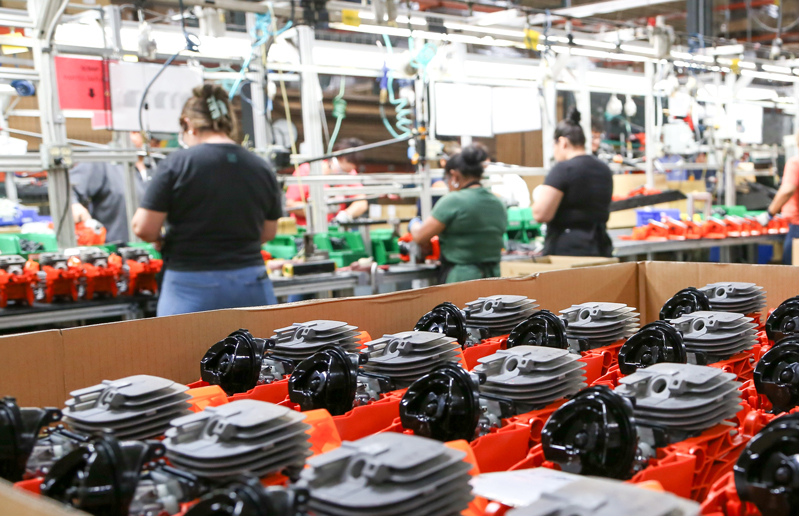
The new power tool products are manufactured at a different time of the year from the Greenworks mowers, blowers and other OPE products. That’s the efficiency Chen mentioned. It manufacturers power tools and power equipment on different lines and different areas of Greenworks facilities, and sometimes those sit idle, Chen said. “The assembly line is different, but the people are the most important. And the person is most expensive now. The line is not the expensive part.”

As Chen was describing in detail the company’s manufacturing capabilities in Tennessee and Vietnam and China, Kevin Holzworth, president of North America for Greenworks was showing me video on his phone from the company’s highly automated manufacturing lines. While automation makes quantity possible, Chen said, Greenworks relies on high-quality people to deliver the best products they can.
Note: Greenworks is part of the Globe Technologies family of businesses; its brands include Greenworks in America, plus the Cramer brand of power equipment in Europe. In 2016, Stihl acquired a minority stake in Globe, and the two maintain a working relationship.
Chen said part of the efficiency comes from doing a high-percentage of the work itself. “We do 85% of our components in house. There’s no middleman. We do everything,” said Chen.
I asked Holzworth how this Walmart deal came together. I also tried a few times to ask Walmart executives who have not yet responded to my queries.
“We have been in outdoor power equipment with Walmart for three years,” he said. “Each year we’re getting into more and more stores, depending upon the area’s demographics and those types of things.”

Holzworth said they started talking specifically about this expansion last May or June. “Six-month development time,” he said. “This was hyperspeed, but our speed to market is definitely in Yin Chen’s DNA and is now in the DNA of this company. We will move heaven and earth to bring a product to market. Most of the time, it’s really good.”
This launch into Walmart includes some existing and perhaps 12 brand new items, said Holzworth. “We are expanding into Walmart with a lot of new tools, plus some tweaks and specification adjustments to make sure we were as good or better than the competition and at a better value in the marketplace.”
What’s next for Greenworks?
When I last visited with Greenworks nearly a year ago at an event in Tennessee, it was introducing more products under the Optimus brand for professional landscape contractors, working to send the message that it had the right batteries, chargers and equipment to help landscapers move away from gasoline. Now, it’s working to expand into a market of homeowners and DIYers who already trust battery technology and tools. And it’s doing so against established manufacturers such as Ryobi, Dewalt and Milwaukee, which Greenworks specifically targeted at this launch event. Can Greenworks prove its brand reputation against these marques?
“For anyone to come along and try to unseat any of these brands is a monumental task,” Holzworth told me at the Walmart launch event in Georgia. “I think the only way to do that is to bring exceptional product at an exceptional value. Not cheap product, but good value for the customer. Walmart giving us that forum shows we meet their customer expectations as well.”
I asked Holzworth how Greenworks would like its brand to be seen. “To me, some of our competitors are in lab coats and very tech oriented. For me, I would like to be known as, if you’ve got a job to do, call us because we’re going to roll up our sleeves and grab a pair of work gloves, not a smock, and we will get the job done.”
After I spoke with Holzworth, I asked Chen the same question – what do you want the Greenworks brand to mean to people? He referenced Honda, a global engine and vehicle manufacturer well known for producing reliable gasoline engines, in everything from motorcycles to cars to jets. “That’s Greenworks but with battery power, Greenworks power,” he said. “And with Greenworks power today, it’s about the possibility. Honda is about engine power. We are about battery power. That’s our key competence. Does that make sense to you?”

What will In Power be watching for here?
- How might Walmart evolve as a power equipment and tool retailer?
- What will skeptical users think of Greenworks product IRL?
- Do other manufacturers – namely Dewalt, Milwaukee – increase their OPE offerings?
- And what about upstart manufacturers such as Senix, which we have not heard much from recently?

Leave a Reply