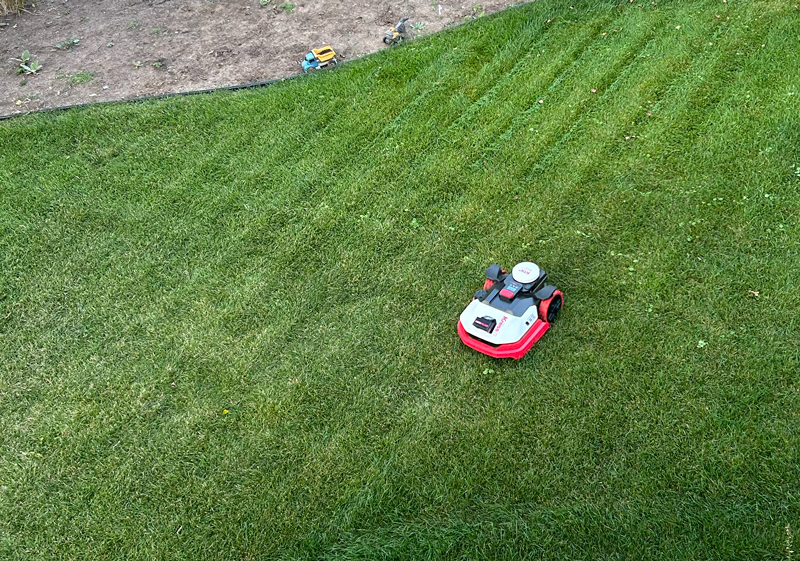
Thanks Lawnie! My Season with a Robot Mower
First of all, don’t sell your push mower. Second, keep your string trimmer handy. Third, enjoy your summer of not mowing the lawn. I did, thanks to Lawnie.
My grandson came up with “Lawnie” after a few other names that did not stick. The anthropomorphizing is important for this service provider. And that’s what it is. The Kress EyePilot robot I used all summer is a service provider and technology device. A smart home tool, an appliance that cuts grass.

When I stopped thinking about it as a lawn mower and embraced it as a service provider, it all clicked for me. And it should for dealers and pro landscapers too.
In this story, I review the Kress EyePilot that maintained my lawn, working for 336 hours and 44 minutes, as of Oct. 18. All the data is available from this technology service provider. I’ll also tell you about my neighbor’s experience with his Segway Navimow, and I’ll share some conversations I had with industry professionals.
Best-looking lawn in the neighborhood
That “best-looking lawn” award is not real, but if it were, I would win it. And the credit goes to Lawnie. You have heard of the science behind robotic mowers boosting the health of lawns. Cut less of the grass blade more frequently and grass is healthier (the University of Georgia has studied this).
Grass health was not my goal. I just don’t like mowing the lawn. I used to push my mower around the yard (in the pre-Lawnie era) every five or six days, depending on how much rain we get in Stillwater, Minn. I’d spend at least an hour on the cutting and clean-up, longer when I did the string trimming too. That’s nearly 40 hours of work time over the summer – a boring task of following my push mower around the yard.
Today, I spend about 20 minutes twice a month on trimming. Lawnie and other robot mowers can’t do the edging, though a few manufacturers have tried to add edging tools. Even my Kress has an edge trimmer function, though it can’t do what a string trimmer can. That’s one reason I kept my push mower and the trimmer.
Training Lawnie
Kress shipped its EyePilot (model KR276) to me in May and the setup took about 2.5 hours, that’s total unboxing, assembly and lawn mapping time. It’s a two-wheel drive robot designed to cut up to 2.5 acres and it retails for $3,600. On my smaller lawn, I could have used the KR272 model which is designed to cut 0.5 acres and costs $2,500. The difference between the two is in the battery mostly, plus my KR276 has four cutting blades while the 272 has just three. Either way, that’s a sizable investment, and I will cover that later in this article.


Mapping my lawn was simple, and mostly automatic for this Kress mower after a simple connection to my Wi-Fi. I had to direct it across the sidewalk twice, and I had to steer it along the sections where my yard borders neighbors on the east and west sides. The setup app makes this kinda like a video game, and if I still played video games I would have done much better here. I couldn’t get it to follow a perfectly straight line.
One important thing I did not have to do with the Kress is setup an antenna. The robot uses satellites through a technology called RTK or real-time kinematic positioning. Trees or neighboring houses will not interfere with the mower’s ability to know where it is. It mows in the dark too.
The thing to remember is, Kress loaned this product to me and if I had actually purchased this mower, I wouldn’t have thought about any of this; my dealer would have. When you buy a Kress EyePilot, you buy it from a dealer who will bring it to you and set it up. That dealer could even monitor the robot’s daily performance remotely and I, the purchasing homeowner, would do nothing. Sort of like hiring a lawn service, except the lawn service lives on your property – and so you name it Lawnie.
Me? I like having the app, it’s easy to use and informative, and gave me all sorts of ways to create zones and mowing schedules. Adjusting the cutting height, which I could do in increments of 0.04 inches from 3.54 down to 1.57 inches. Changing the direction of the cut to make the stripes look just right. Yes, it does stripe. And turning it on manually when I wanted to show a neighbor, which I did quite often. It also keeps a deep data file and tells owners when to replace the blades.
Service Provider, not a Mower
This is when I learned these robots are not lawn mowers; they are service providers and technology appliances. And this is a good time to introduce you to my neighbor Larry. He bought a Segway Navimow i110 model a year before I began testing this Kress. He bought it online and paid about $1,000.
Larry is a smart guy, no stranger to tech products. During his first summer of use, the Navimow did okay. But not great. Larry had to move the antenna and base station a few times to find a spot with minimal interference. That meant his mower got stuck often. It got worse for some reason in this most recent summer. The Navimow just could not find a signal that allowed it to perform its regular lawn service duties. The worst part of it all for Larry was that he didn’t have a dealer to call for service. And Segway’s support system seemed as disappointing for Larry as his mower’s ability to cut. He would share with me text chats between him and an AI-enabled bot. No, actually, the worst part of it all for Larry was that my Kress – Lawnie – was the star of the neighborhood right next door.

Here’s the thing, tech products have problems and people are okay with that when the service is there to solve those problems. An engineer once told me that “hardware eventually breaks and software eventually works.” That’s true if the support system is there to make it work.
It’s also fair to point out that Larry’s mower cost way less than the Kress KR276 I test, (though that model could easily serve both our yards). Is it worth the difference? That’s an individual decision but consider that Larry spent a grand for a lot of headaches. Also, remember when I said at the beginning of this story to keep your lawn mower? I let Larry use my push mower a few times when his robot was inoperable. Just being neighborly.
It’s difficult and unfair to compare the Kress, a product setup and supported by a dealer, with the Navimow purchased online. Positec, Kress parent company, also manufactures and markets the Worx brand of equipment, including robot mowers. These robots are purchased online and setup by consumers, not dealers, with pricing similar to the Navimow models. The Worx robot mowers are unique because they run off a shared battery platform with other Worx handheld equipment.
The business story
What is the business story behind Lawnie? What is the message for dealers and for pro landscapers?
First, for dealers. If I had purchased through a Kress dealer, I would have called that dealer a couple times for help. My experience as a Kress “owner” was very good; I’d give it 4 out of 5 stars. But it was not perfect. A couple times in the first month of ownership, Lawnie wandered over some edging into a new flower bed. It could not back itself out so Lawnie sent me a “Trapped” error message. He also got stuck once under some tall grass wet from an overnight rain.
I had to rescue Lawnie both times, but he learned to not get stuck in both those areas. He never got trapped again. Just last week in an all-day rain, Lawnie sent me a text message saying it was Going Home due to a Dirty Camera Lens. I wiped the lens clean and Lawnie went out again.

In either of those cases, a dealer could have come to solve the problem. In fact, that’s what Joe Langton told me about a year ago. Langton is a dealer of robotic mowers and uses them in landscaping businesses he owns. He told me that he often prefers that his robot mower customers don’t even use the app. His team will take care of all service calls, charging the customer a small fee for the work. Again, these are not mowers; they are service providers that can be managed by a selling and servicing dealer.
This “service” aspect came up in a recent conversation I had with Honda’s Barry Dlugasz about the power-equipment company’s short-lived effort to sell the Miimo robot mower in the U.S. Dlugasz said that lawn mower dealers are accustomed to simply moving products out the door. In-shop equipment service is good for dealers, but most are not equipped to be home-service providers. American lawns and lawn owners often need that type of care, and Honda pulled the Miimo robot mowers out of American retail.
For landscape professionals, the business story is evolving. My neighbor Larry bought a robot instead of continuing with his lawn maintenance service. Before buying the Navimow, Larry contracted with a local lawn service provider. Neither experience has been satisfactory. As these robot mowers get better and less expensive, they may steal more business from commercial cutters.
What’s more likely to happen, however, is that commercial cutters buy robots and set them up on residential properties. A Kress like mine, for example, could be mapped to mow both my lawn and Larry’s adjoining property. A landscaper buys it for $3,500 (maybe less), drops it on the property and it mows for six months. Charge both me and Larry $200 per month, which includes twice-per-month string trimming, and the mower is paid for in 1.5 seasons ($400 / month for 6 months of mowing). Sure, there are personnel expenses in the trimming service to change the profit margin, but the math still works long-term. And the mower’s warranty lasts for five years.
Leasing is a new option that manufacturers are considering. “We are thinking about it,” said Andy Grayson, head of product development for Positec (Kress parent company). “We have some dealers already leasing mowers.”
Whether through a lease program or not, Segway sees the business of robots evolving now into a RaaS model, or Robotics as a Service. “We’re seeing the industry shift,” said Tony Ho, Segway Navimow’s VP of business development. “We have a few customers who do nothing but robotics as a service. We actually call them a different category. We have a traditional landscaping company and then there’s also a RaaS company. These companies buy a fleet of robots and they tell people, ‘okay, we’re going to put a robot on your lawn.’ They are essentially charging the same amount of money, maybe even less compared to the traditional landscaping companies. And then they send a person to do the trimming and also pruning or other things throughout the season. We see a few companies that have switched to that model.”

What’s next?
Robotic mowers are getting bigger and better, technology wise. We are not that far removed, time-wise, from ground-wired robot mowers. That’s simple evolution for nearly every tech product (I’m not talking about tech services like social media and the like, and let me recommend a book called Enshittification, which you can buy at your local bookstore or find at the library near you).
Navimow has a new Terranox Series of mowers designed for commercial turf fields. Interesting, the brand is also working to change the conversation away from “Segway” and turn it toward “Navimow.” Tony Ho told me that many people know the Segway name as originally a mobility toy for rich people, and now a micromobility product for young people, “with scooters and e-bikes and all short distance transportation. It’s for a younger crowd,” said Ho. “The lawnmowing business is the complete opposite. It’s usually older folks, mostly men who take care of their yards, and who own a house. The Segway branding is kind of tricky for that target audience.”
On the Positec side, the Kress brand recently launched its 60-in. Voyager robot for commercial applications. It can be mapped to mow several properties and will drive itself on and off a trailer. Even newer, the Kress Master Series is designed for golf courses and sports turf and can cut 20 acres in 48 hours, said the manufacturer.
I asked both Navimow and Positec about recent sales results, and both say, essentially, sales are great and we can’t give you specifics. “Our sales are trending through the roof actually,” said Grayson from Positec. He mentioned the four-wheel drive robot mowers specifically. Americans, it seems, love 4x4s even if they don’t need ‘em.
The residential market is flooded with robot mowers sold online. I will continue reaching out to these companies to learn more about their products and sales. And I’m also following the news I reported on recently about the federal government requiring foreign makers of robotic equipment to prove they’re safe for American use.
Equipment dealers and landscape pros should look more closely at robot mowers. With the price of battery-powered push mowers climbing over $1,000 (with batteries), and the prices of robot mowers falling, the cost barrier is changing for consumers. Through retail sales or a leasing model, the robot mower option is becoming more attractive for residential buyers. Just like my lawn is more attractive after a season with Lawnie.
Leave a Reply