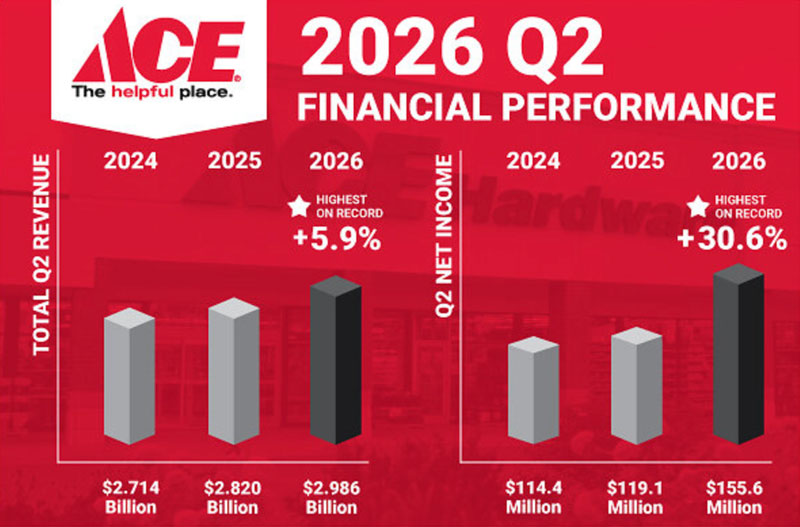
On Aug. 12, Ace Hardware reported Q2 2026 revenues of $3.0 billion, an increase of $165.8 million, or 5.9 percent, from the Q2 2025. Net income was $155.6 million for the second quarter of 2026, an increase of $36.5 million from the Q2 2025.
The results, according to John Venhuizen, president and CEO, came from “solid same-store sales growth, double-digit digital growth, continued expansion of our store footprint, and the entrepreneurial spirit of our local retailers.”

Approximately 4,000 Ace retail stores in the U.S. consistently share daily retail sales data (from a total of more than 5,200 Ace retailers) and they reported a 1.1 percent increase in U.S. retail same-store-sales during Q2 of 2026. This came from a 3.1 percent increase in average ticket partially offset by a 1.9 percent decrease in same-store transactions.

Ace reported it saw revenue increases across most departments with the largest gains coming from grilling, outdoor power equipment, paint sundries, and impulse and front end.
Ace added 34 new domestic stores in the quarter and cancelled 17 stores. This brought the Company’s total domestic store count to 5,283 at the end of the second quarter of 2026, an increase of 88 stores from the second quarter of 2025.
Wholesale gross profit for the quarter ended July 4, 2026 was $399.6 million, an increase of $37.0 million from the same quarter in 2025. The wholesale gross margin percentage was 14.8 percent of wholesale revenues in the second quarter of 2026, up from 14.2 percent in the second quarter of 2025.
In Power will be comparing these revenue numbers with those from Home Depot and Lowe’s when the big box stores report on Aug. 18 and 19, respectively.
Does Ace track with national retail sales?
Meanwhile the National Retail Federation reported retail sales numbers to date, like it does each month. It showed that retail sales rose again in July for the 10th consecutive month.
The NRF reported that total retail sales, excluding automobile dealers and gasoline stations, were up 0.32% seasonally adjusted month over month and up 5.15% unadjusted year over year in July.

Core vs Total U.S. Retail Sales July 2026
The Retail Monitor calculation of core retail sales was up 0.30% month over month in July and up 4.72% year over year. Total retail sales excludes auto and gas sales. Core retail sales further excludes restaurant sales numbers.
“Retail sales maintained their steady upward momentum in July as consumers kept shopping despite ups and downs in other economic indicators,” said Matthew Shay, NRF president and CEO. “Supported by a low unemployment rate and steady wage gains, households remained budget conscious but took full advantage of midsummer sales and early back-to-school promotions to stretch their dollars. Retailers helped balance budgets by remaining committed to affordability, ensuring that everyday products remain accessible for American families.”
Other data In Power found shows that Shay’s claim of “steady wage gains” and “affordability” might be more opinion than fact. Economist and professor Justin Wolfers reports, “Prices are rising quickly, but the average American’s wage is not rising anywhere near as fast. In economist-speak, real wages — that is, your wages adjusted for inflation — are falling: the amount you can buy with the average paycheck is lower today than it was a year ago.”




Leave a Reply